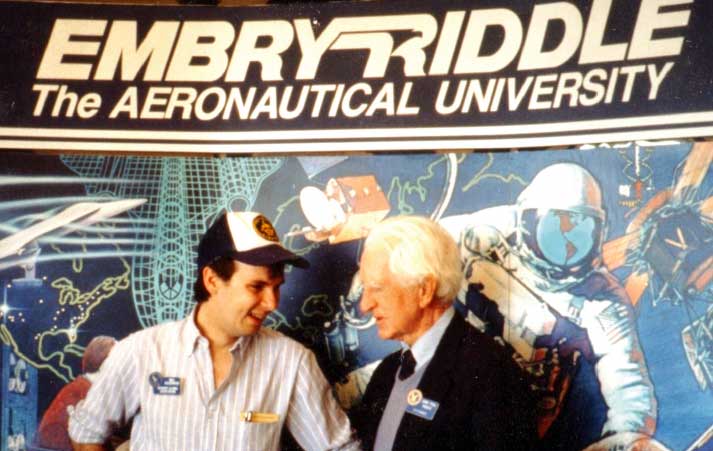
When I started at the university in the fall of 1977, I thought J. Paul, as he was known, had passed long before. But no: He was alive and well, living in Miami. In the early 1980s, Dean Robert Rockett and Jean Snyder, secretary of The Avion student newspaper, decided that J. Paul should be with the students more. So Snyder hosted a get-together at her home, and Dean Rockett drove to Miami to bring him to Daytona. That’s when I first met him.
J. Paul, who was aviation history personified, would start telling stories and naming obscure aviation pioneers. He’d often go into a story that was pure unrecorded history, which left you wondering if it was fact or just a yarn. My all-time favorite: the one about how spin recovery was discovered.
“We were all sittin’ around the line shack in Cincinnatuh when old [Lloyd] Stearman comes marchin’ in, braggin’ that he can do a spin and recover. Now in those days if you got your airplane into a spin, you were just dead, because there was no way to get out of it. So we all just said, ‘Bah, yer full of it.’ But he insisted he found out how to do it. Then he says he’ll prove it. So out to his airplane he goes, and we all went out to watch old Stearman kill himself. He goes up, puts the airplane into a spin, goes around one, two, three times — and the darned thing recovered! Then he goes up and does it again, and again! Well, he lands, and we all run out and line up askin’ him to teach us how to do that! And that was the day spin recovery was invented.”
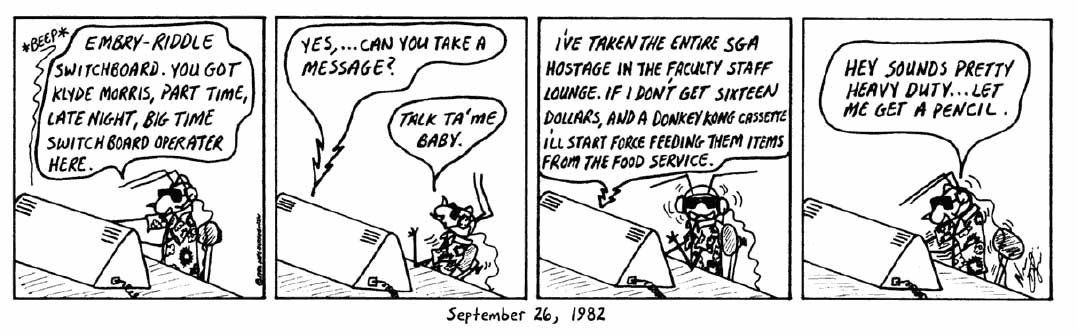
When J. Paul was in the “UC” dining room, students flocked to him. I tried to see him every time, and even featured him in my cartoon strip, “Klyde Morris” [pictured below], which ran in The Avion.
At the Valiant Air Command airshow in March 1988, I was working the Embry-Riddle Student Alumni Association booth when J. Paul stopped by. That surprised the heck out of me. I spent the rest of the show telling every student and alumnus who came by that Mr. Riddle was here, and they took off looking for him. To us, he was more important than the airshow itself.
In the late 1980s, a bunch of them got together and obtained a Waco biplane just like the ones J. Paul used to sell. The alumni surprised him with a presentation of the aircraft on the Daytona Beach Campus. My friend Brian, nicknamed “The Amazing Binzo,” looked at me and said, “I know Mr. Riddle. He’s gonna take one look at that aircraft and find something wrong.”
When the Waco was unveiled, J. Paul looked at it and said, “It’s the wrong color.” I had to bite my lip. Binzo just looked down and quietly said, “I told ya.” It turned out his plane had been painted “Vermillion,” a custom color by Randolph Paint Company. This plane was cream. Then J. Paul walked around the Waco and told the crew how much he admired their restoration and how great the fabric work was. He said it made him want to jump right in and take her for a spin.
When my wife, Teresa (’88), and I got engaged, J. Paul found out before my parents did.
“You better invite me,” he ordered.
The wedding was held during the 1988 Homecoming on the Daytona Beach Campus. And J. Paul was there. Just before we left for the reception, he shook my hand, leaned over and quietly said, “Honesty and integrity. Say it loud on this campus and say it often.”
“Count on me, sir,” I replied. That was the last time we spoke. John Paul Riddle passed away the following April at the age of 87.
Wes Oleszewski earned his B.S. in Aeronautical Science in 1988. This story is an excerpt from his newest book, Nonstandard Approach.