On most campuses, there’s a landmark — official or unofficial. A statue. An old oak tree. A shaded quad where students cram for exams, balance impossible schedules and sometimes fall in love.
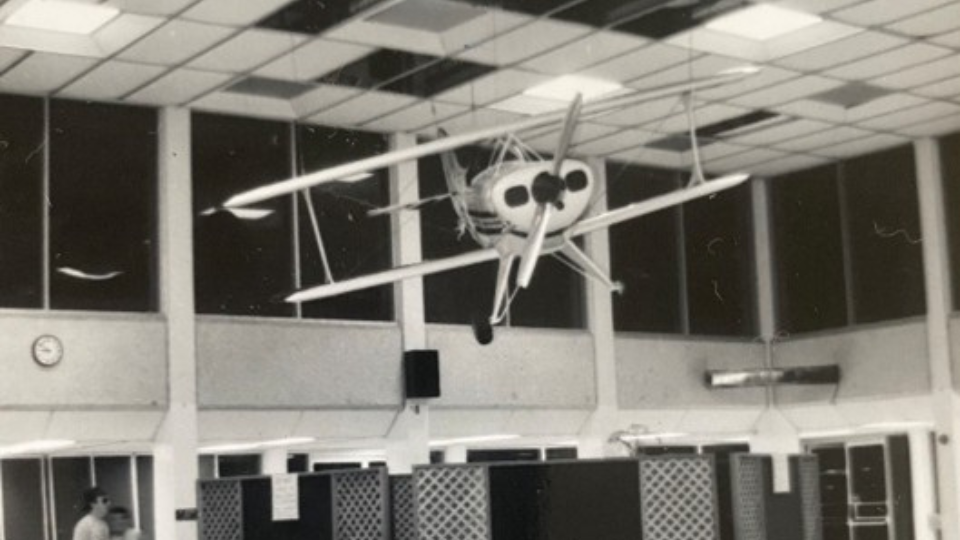
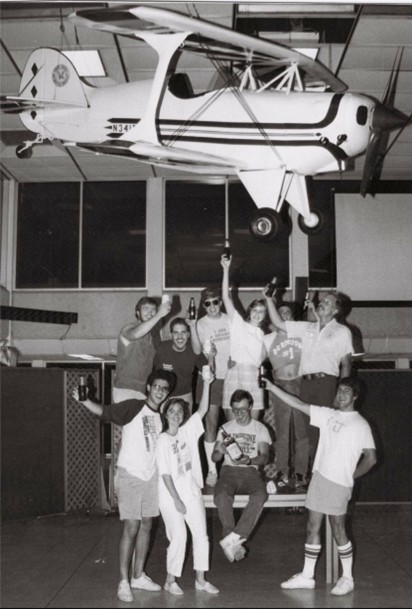
At Embry-Riddle in the late 1980s and ’90s, those gatherings were sometimes beneath the wings of a Pitts Special aerobatic biplane. Suspended from the ceiling of the John Paul Riddle Student Center, it watched over Eagles — red and white, small and still.

The student helping lead the effort to bring the biplane back wasn’t born then. Charles Suroski (’25) grew up on Florida’s Gulf Coast near Fort Myers, where the water was never far and airplanes were something you looked up at with wonder. He knew early he wanted to be an engineer. He also wanted to stay near the coast. That narrowed his choices. Embry-Riddle stood apart.
“They had more aerospace,” he says. “And I liked aircraft and all that kind of stuff. So it became my No. 1.”
He arrived in Daytona Beach as an engineering student surrounded by pilots. One day, walking past a club fair, something stopped him: an airplane sitting on the grass.
Barefoot Flying Club
“I figured I’d go check that out,” he says. “And then I realized — they’re not just pilots. They’re engineers. They’re maintenance. They’re doing everything.”
He joined the Barefoot Flying Club. A year later, when the club’s president stepped down unexpectedly, Suroski stepped up — alongside a small leadership team — and stayed. The Barefoot Flying Club provides restoration know-how to Hammerhead Aviation, a campus club focused on aerobatic competitions.
“I figured I’d go check that out, and then I realized — they’re not just pilots. They’re engineers. They’re maintenance. They’re doing everything.”
Charles Suroski (’25)
He graduates this spring with a degree in Mechanical Engineering and a job already negotiated. A reliability engineering internship at a Jacksonville firm liked him well enough to turn it into a job offer before he finished his degree.
He is not a pilot. His father is. Most of his friends are. He flies with the club when he can and plans to get his certificate someday, when engineering school stops consuming his calendar. For now, that can wait. The airplane cannot.
He’ll tell you the Pitts is light enough to seem impossible — and yet it works. That’s the appeal. And the problem that keeps a mechanical engineer returning to the hangar.
The Hangar
Barefoot Flying Club doesn’t run like most student organizations. No dues. No mandatory meetings. No rigid structure.
Instead, there are hangars — three stitched together into one working space across the airfield. On any given afternoon, 15 to 20 students are there. Some sand spars with careful hands. Some trace wiring or study diagrams. Others sit with textbooks open, the smell of epoxy and fabric in the air.
The club has more than 250 registered members and a backlog of more than eight aircraft in various stages of restoration. They rarely buy pristine planes.
“We usually don’t buy airworthy aircraft,” Suroski says. “We want things our members can work on.”
That might mean flying to West Virginia to inspect a project or hauling back connected parts that barely resemble an airplane. Then the real work begins.
Problems aren’t assigned. They’re set in the middle of the room.
“We’ll tell members, ‘Here’s the problem — figure it out,’” he says. “Then we compare what they come up with to what we’re thinking.”
Final decisions run through Suroski and a small group of experienced members, including certified mechanics. The process stays open. It’s engineering without deadlines or grades. A place to try, miss, adjust.
It feels like something older. Closer to apprenticeship than coursework.
The Plane They Never Saw
During campus visits in his later years, John Paul Riddle would pull up a chair in the student center that bore his name and talk with students about aviation’s past and their futures. The Pitts Special hung overhead.
The airplane first served as a training platform for Aviation Maintenance Science students. Then a group of those students decided to put it where everyone could see it.

In June 1986, they moved it onto campus and hung it from the ceiling in two days. Inside the cowling, they left a handwritten message:
“This aircraft refurbished, and hung by amateurs, by God we pray she’ll stay… Dedicated to the memory of all our lost brothers and sisters in aviation.”
The students who came after didn’t know the story. They only knew the airplane was there — and that being beneath it mattered.
They studied under it, ate lunch under it, talked about life under it. Some proposed under it.
“We’ve been married for 28 years now,” recalls Brian “Ferg” Fergson (’93), later a technical advisor and aerial coordinator on Top Gun: Maverick. “We actually met at Embry-Riddle in the old student center underneath that Pitts S-1 they had hanging there.”
It stayed until 2019, when the student center was demolished and replaced by the sleek, swooping Mori Hosseini Student Union. The Pitts was stored away as a bit of nostalgia.
The Work
The Pitts is smaller than memory makes it.
Stripped down across two connected hangars at Daytona Beach International Airport, it appears delicate — light enough that a handful of students can lift sections overhead, narrow enough to reach an arm through one side and out the other.
The aircraft will never fly again. The goal now is to preserve it for display.
“We’re keeping the outside the same, but inside, we’re making it safer.”
Charles Suroski (’25)
Time has left its marks. Softened grain in the wood. Weakening near old suspension points. Damage that only shows when you start taking things apart.
“If we hung it as it is,” Suroski says, “the wing would just snap.”
So the work slows down.
They protect what can be seen: the paint, the markings, the signatures left by the students who hung it in 1986.
At one of those suspension points, rot had eaten clear through the wood. They built a mold around the damaged section and poured in marine epoxy and fiberglass, creating a new structural core — stronger, in that spot, than what had been there before.
It’s the kind of repair you don’t notice unless you know where to look. Load paths rerouted. Stress redistributed. Failure avoided.
“We’re keeping the outside the same,” Suroski says. “But inside, we’re making it safer.”
It is restoration with a light touch — hands from a new generation working carefully around the work of another.
The Return

No one knows where the Pitts Special will land next.
Suroski is handing off the project as he graduates. He told his successor, “It’s not like being president of any other club,” he says. “You’ve got a lot of work to do.”
The new president agreed. That satisfied Suroski that Barefoot Flying Club and Hammerhead Aviation are in good, if busy, hands.
Because long before Suroski and his teammates arrived — before the club fair, before the hangars, before the first careful repair — students were already gathering beneath that Pitts Special.
Studying. Talking. Looking up.
Imagining what it might mean to build something that lasts.
Now, across the airfield, another group is doing exactly that.