Embry-Riddle Aeronautical University students are working to solve challenges in space travel today. In laboratories, NASA competitions or in the field, there is always a chance for discovery when these inquisitive minds reach for real world solutions.
Quenching Thirst on the Moon
Every future lunar mission turns on the same unglamorous question: How do you keep astronauts hydrated hundreds of thousands of miles from the nearest tap?
In June, a team of Embry-Riddle students traveled to Huntsville, Alabama, with an answer — and returned with third place at NASA’s 2026 Human Lander Challenge.
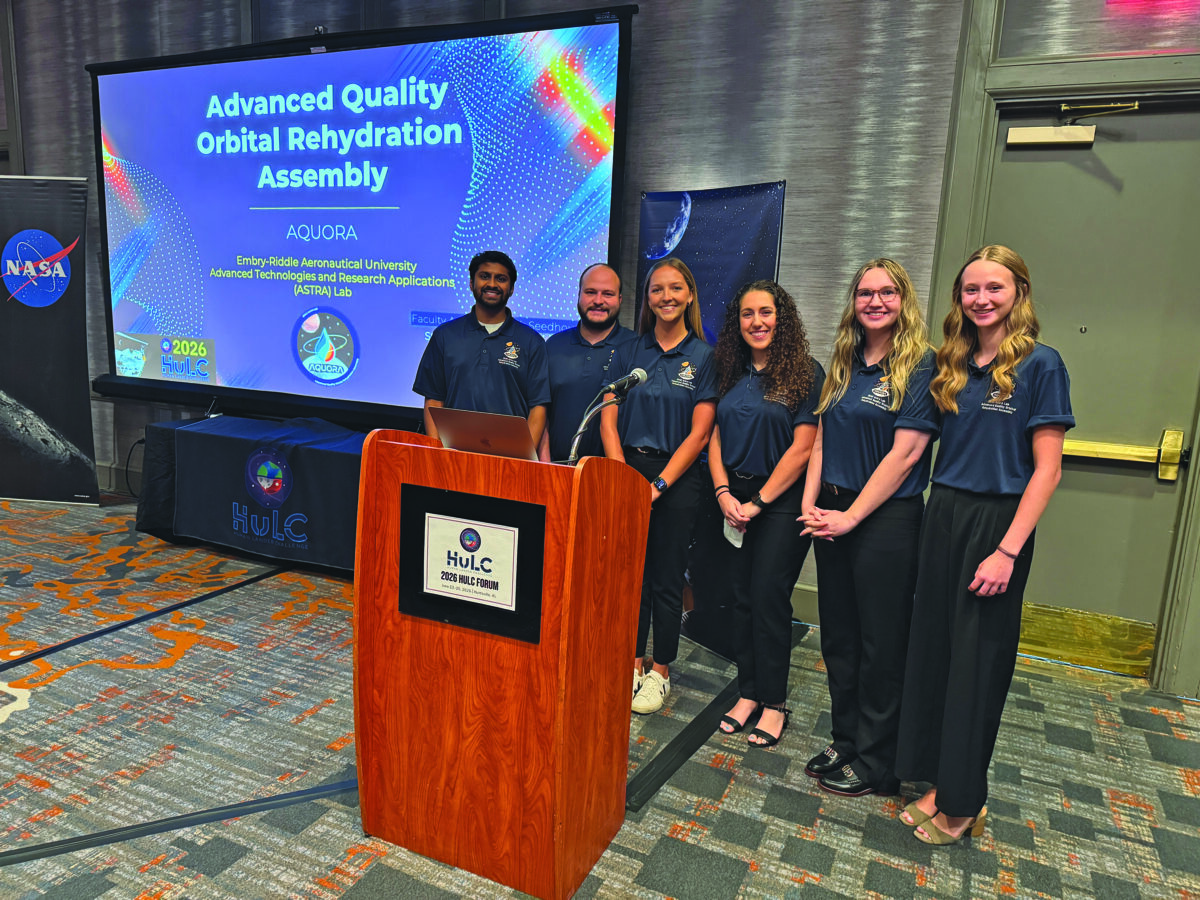
Space Operations major Karlie Jerrell (’27), who is minoring in systems engineering, served as lead engineer for the Daytona Beach Campus team’s Advanced Quality Orbital Rehydration Assembly, or AQUORA. The concept addressed a deceptively complicated problem: providing astronauts with safe drinking water while also considering crew comfort during long stays away from Earth.
Cold water was a baseline requirement for every potable water dispenser submitted at the forum. Teams could choose whether to take the concept further. AQUORA was the only one that did, proposing sonication (high-frequency sound waves) as a method of microbial control.
The stakes are more than academic. The International Space Station historically recovered about 93% to 94% of crew water from sources including humidity condensate and urine. With the addition of a brine processor assembly, NASA has demonstrated 98% total water recovery. Future lunar landers and surface habitats will have far less room, redundancy and routine resupply, making water quality, reliability and storage life critical.
For Jerrell, AQUORA offered another scarce resource: the chance to see an engineering project through from problem to proposal.
“I went into AQUORA with very little hands on engineering experience. Leading the engineering team gave me the opportunity to see how the entire engineering cycle comes together, from defining the problem and working through design decisions to integrating different disciplines and presenting our final concept. Watching both the project and the team develop throughout that process was one of the most rewarding parts of the experience.”
“Student participation in this competition is significant because it provides hands-on experience in engineering design, problem-solving, teamwork and collaboration within a highly competitive and professional environment.”
Dr. Erik Seedhouse
Water dominated the podium. Cal Poly’s first-place Peltier-based Hydration Accumulation Terminal, or PHAT, and Purdue University’s second-place enhanced potable water dispenser also tackled crew hydration. AQUORA took third with its approach to safe water access and astronaut comfort on longer missions.
The 12 competing teams explored a wider range of environmental-control and life-support challenges, including oxygen generation, noise suppression, medical equipment, sensors and fluid-transfer interfaces — systems NASA will need to refine before astronauts can live, not merely visit, beyond Earth.
Dr. Erik Seedhouse, associate professor of Applied Aviation Science and the team’s faculty adviser, says the value extends well beyond the competition.
“Student participation in this competition is significant because it provides hands-on experience in engineering design, problem-solving, teamwork and collaboration within a highly competitive and professional environment.”
Embry-Riddle’s Prescott Campus also fielded a finalist: AETHER, an oxygen generation concept that converts carbon dioxide into usable oxygen. Led by the Professional Association of Research for Space Engineering Concepts (PARSEC) student organization, the Prescott team reached the Human Lander Challenge finals for a third consecutive year, following a first-place national finish in 2025 for a project using machine learning and electrical capacitance tomography to measure propellant quantities.
A Spaceport Becomes a Classroom
Cecil Spaceport does not look like the popular image of a launch site. It looks even less like a classroom. But it is where Justin Robinson (’27) is learning to build rocket engines.
On Jacksonville’s Westside, the former Naval Air Station Cecil Field offers something few university laboratories can: a 12,500 foot runway and an active, FAA-licensed spaceport. Designated for commercial horizontal-launch operations in 2010, Cecil was the first licensed facility of its kind on the East Coast. Today, the Jacksonville Aviation Authority operates Cecil Air and Space Port under a license renewed through 2030.
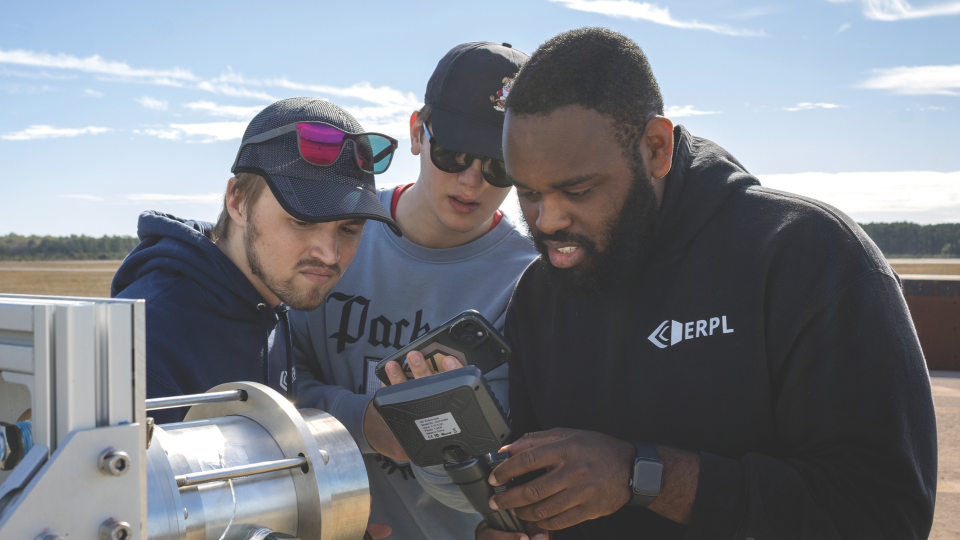
It is also where successive teams of Embry-Riddle undergraduates have been pushing their rocket hardware to its limits. The university’s Experimental Rocket Propulsion Lab (ERPL), a student-run organization within the Daytona Beach Campus’s Department of Aerospace Engineering, has made Cecil its proving ground.
In 2023, the club successfully hot-fired Odyssey, a hybrid rocket engine developed for its lander challenge entry. Producing more than 500 pounds of thrust, the test established the feed-system, data-acquisition and operating foundations for subsequent work at Cecil.
The next milestone was Triton, an ethanol-and-liquid-oxygen engine designed to produce approximately 1,000 pounds of thrust. Robinson, then a freshman, helped build and test the engine, which became the most powerful in ERPL history at the time and the first designed and built by freshmen and sophomores. The team completed successful hot fires at Cecil in spring 2025.
“Being able to test at a facility like Cecil Spaceport alongside major corporations such as Boeing and others really puts into perspective how rapidly developing the aerospace industry has become.”
Justin Robinson (’27)
The students have also been building the infrastructure needed to test their creations. Draco, ERPL’s mobile liquid-engine test stand and propellant feed system, accommodates both ambient-temperature and cryogenic propellants. When an engine anomaly damaged the stand in early 2026, a team of first-year students rebuilt key systems and returned it to operation that spring.
For Robinson, now a senior, testing at Cecil offers an education that extends beyond propulsion.
“Being able to test at a facility like Cecil Spaceport alongside major corporations such as Boeing and others really puts into perspective how rapidly developing the aerospace industry has become,” he says. “By providing ERPL with a safe and robust place to conduct testing, Cecil opens the doors for students to gain the hands-on experience that many top aerospace companies are looking for.”
Cecil’s ambitions extend beyond its current horizontal-launch license. The Jacksonville Aviation Authority has authorized efforts to pursue a reentry license and develop a space-vehicle facility, potentially expanding the site’s role in commercial spaceflight, subject to FAA approval and the availability of vehicles ready to use it.
Those plans bring questions that go well beyond launching a spacecraft: logistics, ground support, infrastructure management and safety. They are the systems that must be in place before commercial spaceflight can become routine.
They are also questions Embry-Riddle has spent a century preparing people to answer.
At Cecil, students learn more than how to make an engine fire. They develop testing procedures, troubleshoot equipment, manage safety protocols and operate within an active, federally licensed facility. Their education unfolds at a spaceport preparing for its own next chapter.