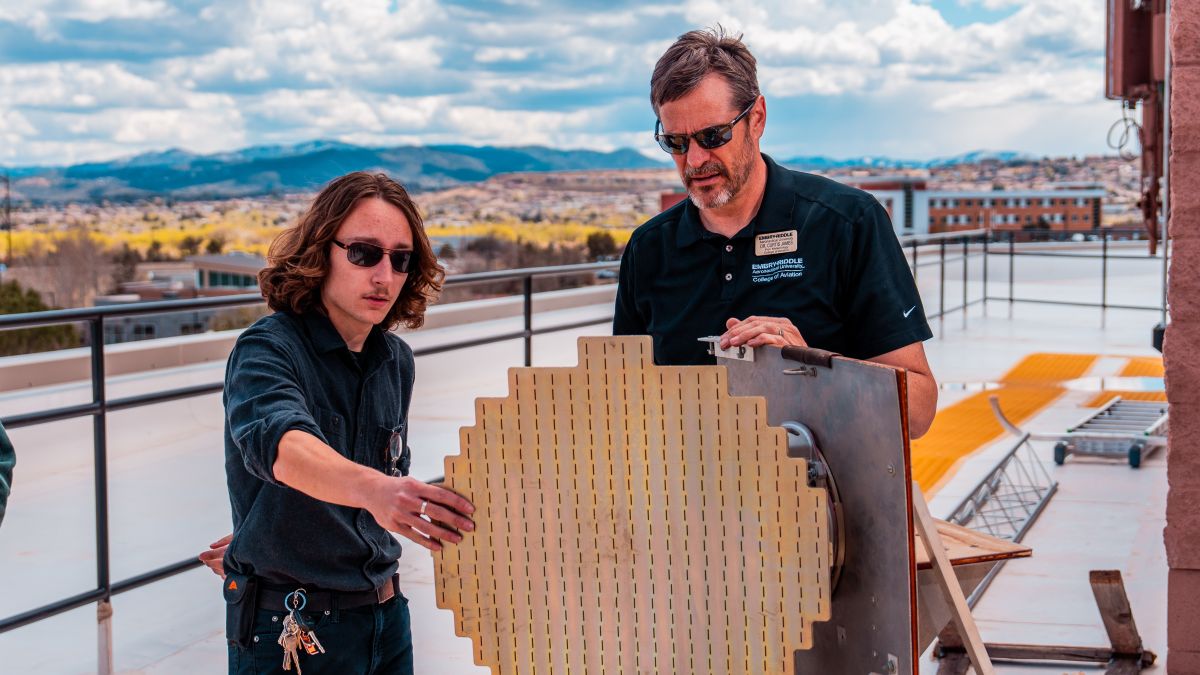
A roof on the Prescott Campus was the launch pad for Allayna “Ally” Allman and Sawyer Curless, two ambitious student engineers who installed a Honeywell weather radar that will serve as an educational tool for student pilots and meteorology students.
The heart of the project is the Honeywell IntuVue RDR-7000, a sophisticated weather radar system originally designed for commercial jets. The radar provides advanced detection, analysis and weather-avoidance features, pinpointing dangerous conditions such as turbulence, wind shear (sudden shifts in wind speed and direction) and severe storms. For pilots, this translates into critical, real-time information for safer navigation.

“We’re giving pilots the power to compare what the radar sees with actual conditions right here in Prescott,” Curless explains. “That’s a huge advantage over relying on general weather reports.”
Dr. Curtis James, a professor of meteorology, leads this effort and applauds the new addition as a resource advancing research and the student experience. He also appreciates the opportunity Honeywell has given students to tour labs and the research center in Deer Valley, Arizona, where radar technologies are developed — a visit he called “some of the best hands-on learning we could ask for.”
Students will learn to interpret the data in the context of locally observed weather at a range of at least 93 miles. The project also aids Honeywell engineers since automated hazard detection for turbulence, lightning and hail can be compared with other available data for algorithm verification.
Adapting this sophisticated system for a stationary, ground-based installation was no small feat. “We had to rethink the entire setup,” says Levi Brown, a Honeywell engineer and project advisor. “This radar was designed to be in a jet, so we re-engineered it to run on a laptop, unlocking its full potential for Embry-Riddle’s students.”
Another unique aspect of the project is that the company retains access to the installed radar for live-fire testing — real-world signal testing not available in controlled lab environments. The setup allows radar signals to reflect off real obstructions like clouds and terrain, verifying accuracy in ways impossible to replicate in a laboratory setting. Brown explains, “We provide you with a radar, and occasionally, if we need to do live-fire roof testing, I’ll call Professor James and ask if we can use it while we set ours up.”
Rudy R. Miller — chairman, president and CEO of Miller Capital Corporation — supported the project after he met Dr. Curtis James and fellow College of Aviation Aerospace Advisory Board member Paige Konieczny (’20), a meteorologist with the National Weather Service in Flagstaff, Arizona.
“We’re giving pilots the power to compare what the radar sees with actual conditions right here in Prescott. That’s a huge advantage over relying on general weather reports.”
Sawyer Curless, Computer Engineering major
“Paige’s passion for meteorology fired me up to become more involved with the College of Aviation meteorology program,” Miller says. “After meeting with Dr. Curtis James, Paige Konieczny, and student engineers Ally Allman and Sawyer Curless, I understand their motivation and excitement.”
The RDR-7000 is now perched atop the Prescott Campus AC-1 building to feed live data to a website designed by Allman and Curless. “It’ll show both the radar’s readings and actual weather conditions in real time,” says Allman, whose internship at Honeywell has been extended.
Although it was technically challenging to get to this point, both students are enthusiastic about the project’s potential. “It’s fun to work up here,” Curless says. “And it’s exciting to know what we’re building will help students and pilots access better, real-time weather data.”