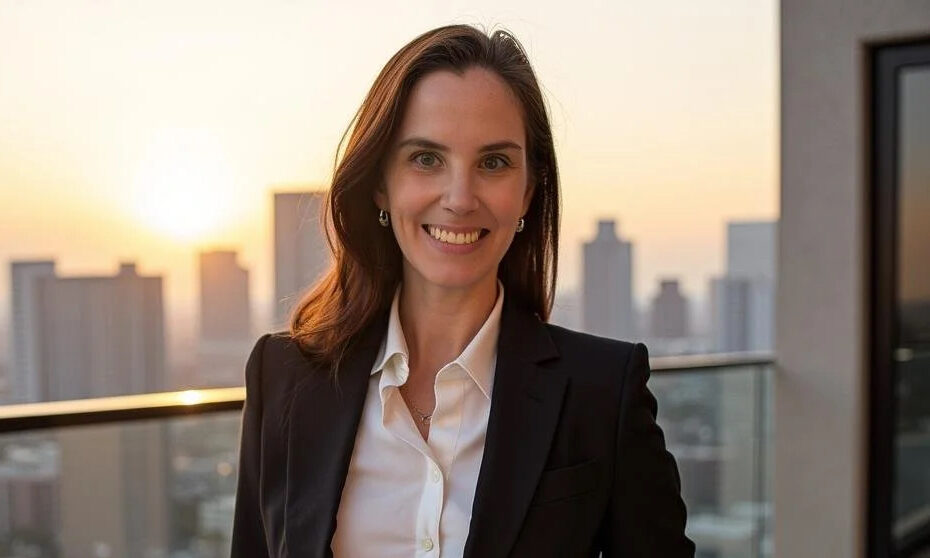
When Aerospace Engineering major Ashley Fairman (’05) stepped into Dean Ron Madler’s office at Embry-Riddle’s Prescott Campus, she believed her dream of an Air Force commission was finished.
“I had missed a deadline that could have cost me everything,” she recalls. “I walked in terrified and crying, ready for him to tell me it was too late.”
Madler didn’t scold. He simply asked, “Did you ask anyone for help?”
When she said no, he leaned forward. “Ashley, you don’t get what you don’t ask for. Leaders ask.”
Then he mapped out a way back. There were extra steps, extra accountability but renewed belief. “He didn’t make it easy,” she says. “But he made it possible. That moment changed how I see leadership. Asking isn’t weakness; it’s courage.”
That exchange became her compass. Learning to ask opened every door that followed and years later positioned her to answer the needs of other women with more ambition than assets.
Rocket Science Instead of Regret
“I was a party kid in high school,” she admits, laughing. “I needed something that would keep me too busy to self-destruct.” People said, “It’s not rocket science.” She decided to test that. “I picked aerospace engineering because it scared me,” she says. “I wanted something hard enough to save me from myself.”
When it came time to choose a campus, she was bluntly self-aware. “If I went to Daytona, I’d be on the beach instead of in class. Prescott was smaller, quieter, and you couldn’t get away with much. I chose discipline on purpose.”
ROTC sealed the deal. “I didn’t grow up with a lot of rules,” she says. “ROTC gave me purpose, accountability and a family. That’s where I first learned what it meant to lead.”
From Bainbridge Island to Big Tech
Fairman grew up on Bainbridge Island, Washington, a postcard-pretty place that could also feel confining. “I cleaned houses in high school,” she says. “I’d be scrubbing toilets, thinking, I’m not going back to this. Not because there’s anything wrong with hard work, but because I wanted options. I wanted to build something bigger.”
That determination carried her through Embry-Riddle’s toughest courses. “When I started I wanted to build vehicles that would go to space,” she says. “Now, in a different way, I create systems that do go to space. It’s the same calling, just a different toolkit.”
For a while she even considered flight training. “I flirted with the idea of learning to fly,” she says. “But I realized I’m most alive solving the invisible problems—the ones inside the systems that make flight possible.”
When she graduated, the Air Force had too many engineers. “They said, ‘You know how to code. You’re cybersecurity now,’” she remembers. “I had zero say in it.”
She resisted at first. “I wanted rockets, not firewalls,” she says. “But once I understood that cybersecurity was about defending people who don’t even know they’re being attacked, I fell in love with it.”
After six years on active duty, she joined the Department of Defense as a civilian, helping draft cybersecurity policy for the Obama administration. “I thought headquarters meant I could make an impact,” she says. “But the bigger the system, the slower it turns.”
A colleague nudged her toward private industry. “He sent me a link to a job at ServiceNow and said, ‘Get out of government. Try big tech,’” she recalls. “That email changed everything.”
At ServiceNow she became known for bridging engineers and executives. “Cybersecurity is like flying. You think fast, communicate clearly and trust your training,” she says. “That combination of logic and language came straight from Embry-Riddle.”
Her success led her to Google, where she managed global cybersecurity programs supporting international operations and enterprise-risk initiatives. “Google taught me how to lead at scale,” she says. “Every challenge there came down to the same principle Dean Madler taught me: ask the right questions.”
Owning Her Mission
Fairman is founder and CEO of DICE Cyber Consulting, helping organizations strengthen digital defenses, manage risk and build ethical technology cultures. “I wanted a company that reflects my values,” she says. “Integrity, education and protection. We work with organizations that want to use technology responsibly.”
Her firm mentors rising professionals—especially women—entering cybersecurity with confidence and purpose. “I know what it’s like to feel like the only woman in the room,” she says. “My mission is to make sure the next generation doesn’t have to feel that way.”
Fairman is also pursuing her Ph.D. in cybersecurity, studying the intersection of digital ethics, leadership and global security policy. “After years of defending systems I wanted to dig deeper into what it means to defend trust itself,” she says.
Working from home, she has colleagues that prove as curious and challenging as engineers: her goats. “They’re loud and way too smart for their own good,” she says. “They remind me to step away from the screen sometimes. You can’t stay tense around goats. They just don’t allow it.”
Defending People, Not Just Networks
Outside her company Fairman works with nonprofits and law-enforcement coalitions that use technology to fight human trafficking. “Traffickers use the internet to hide,” she says. “I use it to find them. It’s the most meaningful work I’ve ever done—turning technology into protection.”
She’s also writing a book that applies cybersecurity principles to mergers and acquisitions, exploring how organizations protect or lose their integrity when systems and cultures collide.
“Everyone talks about firewalls and data,” she says, “but the real vulnerabilities are human. Companies merge their networks faster than they merge their values. My book looks at how security isn’t just a technical concern—it’s a cultural one.”
She continues to collaborate with Embry-Riddle on expanding cyber-studies and workforce-readiness programs. “We’re connecting classroom theory with real-world defense,” she says. “Students shouldn’t just graduate employable; they should graduate ready to lead.”
A Legacy That Keeps Answering
At 42, Fairman has made a planned gift to support scholarships for women in STEM fields at Embry-Riddle. “People my age don’t usually think about legacy giving,” she says. “But you don’t have to be wealthy to make an impact. You can name the university in your will or designate your life insurance. It’s about planting opportunity.”
Her reason is simple and personal. “I’ve been that student, one mistake away from losing everything,” she says. “If my gift helps one woman stay in the program or gives her the courage to ask for help, that’s all I need.”
She still carries that moment in Dean Madler’s office like a compass. “He didn’t just keep me in ROTC. He showed me that leadership starts with a question. Because of him I stopped waiting for permission and started asking better ones.”
She smiles. “Every good thing since—every door that’s opened—began when I stopped being afraid to ask.”