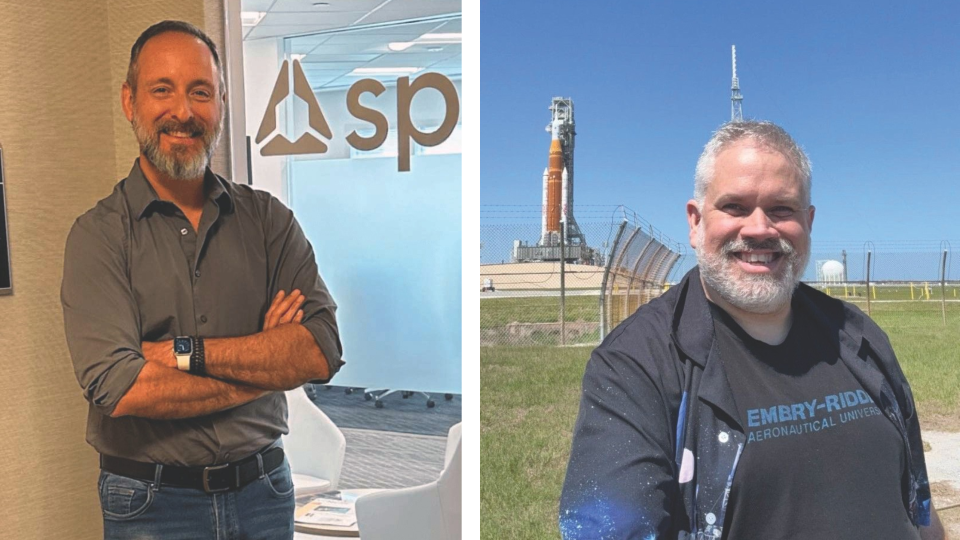
Some career paths run straight from ambition to achievement. The paths of Charlie Krone (’24) and David Hitt (’24) did not — and both men found their way to dream jobs through the same door: Embry-Riddle Aeronautical University’s Worldwide Campus.
Krone spent his 20s on stage, not in a lab. A trombone degree from Indiana University led him into the U.S. Air Force Band, then into the ska scene, touring alongside acts like No Doubt as a member of Johnny Socko. But a childhood memory never faded: His mother once brought home a signed moon map from a stranger she’d met at an airport — a stranger named Neil Armstrong.
The dream of space work had been planted early, then set aside for decades while Krone built a steadier life in audio distribution and marketing software.
Growing up in Huntsville, Alabama — Rocket City — Hitt assumed he would work for NASA. Instead, he studied journalism at Ole Miss, eventually writing for NASA’s education website and moving into outreach and speechwriting. He built a career narrating the missions other people flew, even co-authoring astronaut memoirs and earning a Silver Snoopy — NASA’s own honor for contributions to flight safety — presented by a then-rookie astronaut named Victor Glover.
Both men spent years close to the thing they wanted without quite being part of it.
For both, the way back started with a conversation.
For Krone, it was his wife, whose encouragement sent him searching for a graduate program that could translate an unconventional résumé into space-industry credibility. He found it through Embry-Riddle Worldwide’s Master of Space Operations. The program’s business focus — building a space venture from scratch, analyzing rocket reusability — matched the practical, cross-disciplinary skills he already had.
He graduated in 2024 and now works at Spire Global as a customer success engineer, shepherding client satellites from launch through years of operation.
For Hitt, the conversation came through a chance meeting with Embry-Riddle recruiter Robin Colwell at a Huntsville conference. She saw a path where he saw only a gap and pointed him toward the university’s Worldwide Systems Engineering master’s program.
A brutal nine-week prerequisite course in statistics and calculus felt like a test of whether he’d been right to walk away from engineering years before.
He finished with a 98.
Today, Hitt is a payload integration manager and senior systems engineer at Amentum, supporting NASA’s Space Launch System — the same program he once wrote about from the outside.
On Artemis II launch day, wearing an Embry-Riddle shirt, he watched astronaut Victor Glover — now bound for the moon — clear the tower. Then he texted Colwell: “Look where I am because of you.”