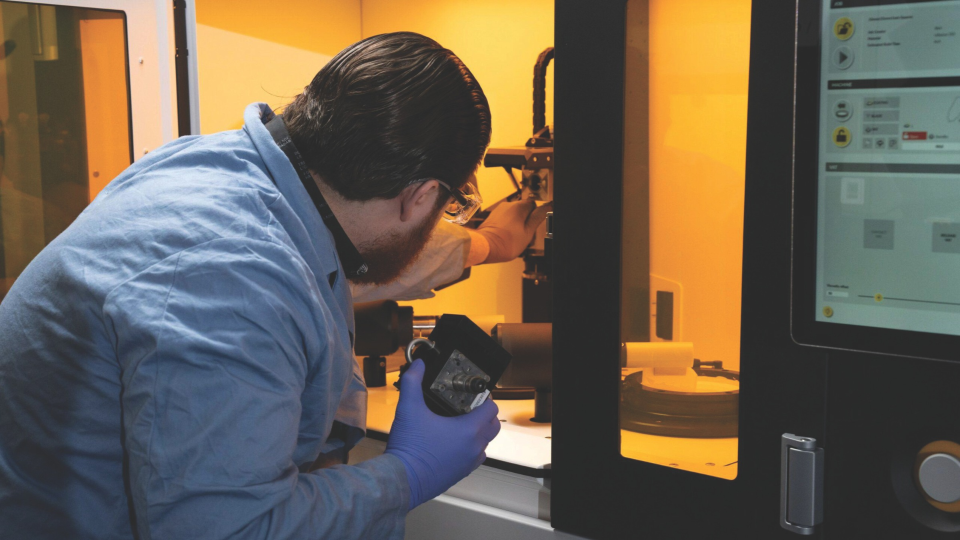
When a ceramic printer weighing more than 1,200 pounds arrived at Embry-Riddle’s Daytona Beach Campus in 2025, it marked a U.S. first: the installation of a Lithoz CeraFab Multi 2M30, capable of combining multiple materials within a single printed component.
Doctoral student Nicholas Reed was among the first researchers to put the machine to work, examining ceramic components on its removable build plate. Nearly 6 feet tall, the printer has a surprisingly modest build envelope — similar in size to a VHS tape. But the future of space manufacturing may depend less on printing enormous structures than on producing small, engineered components that can sense stress, resist dust and perform several jobs at once.
Every kilogram delivered beyond Earth carries substantial cost, making it impractical to transport every component and replacement part from home. Long duration exploration will depend on making better use of available materials and designing components that withstand punishing environments.
That challenge drives research in Embry-Riddle’s Extreme Environments Laboratory, led by Dr. Seetha Raghavan, professor of Aerospace Engineering. The CeraFab’s open-material system allows researchers to combine ceramics with other ceramics, metals or polymers, building complex structures in layers as thin as 10 microns.
“Additive manufacturing with such high precision is extremely novel and definitely something that will shape the future of aerospace.”
Avi Waghray (’27)
One application borrows its design from a lotus leaf. Embry-Riddle’s Ceramic Research Advanced Technology (C.R.A.T.E.R.) team has used the printer to develop ceramic surface patterns modeled on the leaf’s naturally water repellent structure, exploring whether similar patterns could reduce the adhesion of lunar dust.
Undergraduate Avi Waghray (’27), who worked on the project, sees precision manufacturing as an important part of aerospace’s future.
“Additive manufacturing with such high precision is extremely novel and definitely something that will shape the future of aerospace,” he says.
Lunar dust is more than a housekeeping nuisance. Its abrasive particles cling to equipment, interfere with mechanisms and complicate surface operations. Embry-Riddle researchers are investigating how certain materials might help equipment withstand such a hostile environment.
The university is also exploring how to turn lunar and Martian soil simulants into useful materials. Supported by a $600,000 National Science Foundation grant, Raghavan and her students are using a separate direct-ink-writing process to investigate regolith-inspired materials with sensing capabilities.
Sensors manufactured from locally available materials could eventually detect chemical leaks, monitor temperature changes or identify structural damage. Rather than transporting every specialized component from Earth, future crews might manufacture some of the devices needed to keep their habitats and equipment operating safely.
Embry-Riddle’s participation in the emerging Center for Science, Technology and Advanced Research in Space (C-STARS), a multi-university consortium investigating manufacturing and electronics for space applications, could extend that work through broader research partnerships.
A finished CeraFab component may fit in the palm of a hand, but its potential extends well beyond its dimensions. Future exploration systems will need materials that resist dust, detect stress and reveal damage before it becomes failure. The next generation of space hardware may have to tell its crews when something is wrong.