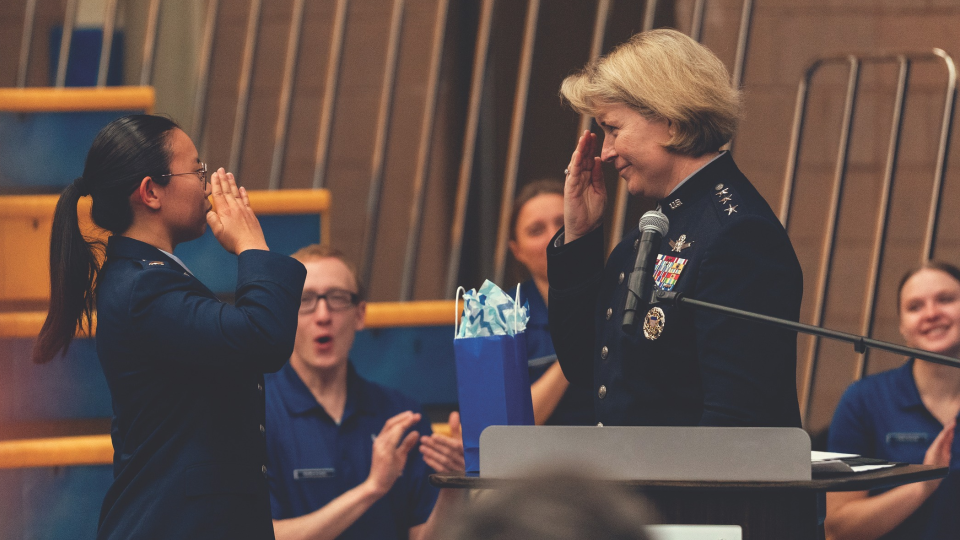
Retired Lt. Gen. DeAnna Burt is one of a rare group. She helped stand up the first new branch of the U.S. military since 1947. After five years of helping build the U.S. Space Force, she’s grateful for the experience — and a little envious of the generation that comes next.
We asked her what goes into preserving the space domain, the role of the U.S. Space Force Guardians and how she thinks Embry-Riddle fits in that picture. “I would trade places with any students at Embry-Riddle right now,” she says, “because I think we’re going to be on the moon and Mars in their lifetime.”
What is the Space Force’s mission?
Where most people get confused is the difference between United States Space Command, which is the combatant command for space, and the service, which is the Space Force. The combatant command is responsible for warfighting on a joint scale. The services provide the trained operators and capabilities to carry out those missions. And that’s what the Space Force does, not only on behalf of United States Space Command, but for all the other combatant commands around the globe.
What does success look like in the Space Force?
We have a theory of success that talks about three elements. One is space domain awareness and understanding what’s on orbit. The second is having resilience and the ability to deny first-mover advantage. I can take a punch and continue to operate. But as every service is required to do, it’s how do I then give a punch back if required? The third element is this: responsible counterspace campaigning.
Unlike the other domains, we operate in a domain where, when something is disabled or killed, it still lives on. If you shoot down an airplane, it falls out of the sky. That’s not the case in space. A dead satellite, debris — if you blow it into a million pieces, all those things remain on orbit, and everyone has to deal with that collateral damage.
It’s not just machines at risk. Think about the International Space Station, commercial space travel and now Artemis. There are humans on orbit. We have no desire to trash the domain. We want freedom of maneuver in the domain as well.
How is commercial space changing the picture?
You must have an industrial base for the service to be successful. You need competitors and multiple people bringing capability to bear to reduce costs for the government. With the reduction in launch costs, you see commercial providers entering the market and building capability.
There’s a variety of things that everyone uses space for in their day-to-day lives. Those same capabilities are sometimes dual use or modified for military applications.
What role should AI play in military operations?
The good part is the dialogue has started about what those guardrails are. My only personal fear is that I don’t know if our adversaries think about guardrails the way we do.
You want a human in the loop making that final decision that you’re going to pull a trigger. AI can enable our operations to move faster and be more efficient, but having that human in the loop to make critical decisions when it comes to applying lethal force is going to be the key guardrail from a military perspective.
Could Space Force someday have a base in space? Would you go?
I think we’re going to have to think about it. How do you protect astronauts if any of those folks are threatened? I hope that’s not the case, but we need to be prepared to do so.
I’m too old to go, though. That’s a young person’s game. You definitely want to send your best and brightest with the best physical stamina because it does take a lot out of you.
What do you miss about military service, and what are you doing now?
You always miss the people and the mission. I’ve continued to serve by working with startup companies and academia and venture capital. There’s a lot of excitement in the space industry, but I miss young Guardians. There are many ways to serve, and I’m happy to give back and keep supporting the mission.
How did Embry-Riddle prepare you for your career?
The Aerospace Engineering program prepared me to think critically and to look at things uniquely. There were about 500 cadets in my ROTC detachment, so I also had a solid military foundation. I thought I was going to do four years and be done, but I fell in love with it and went on to serve for 33 years. Embry-Riddle taught me a lot, got me prepared, and I did very well going right in as a lieutenant.
What opportunities do you see for Embry-Riddle students?
You have an extremely strong STEM program that prepares students to support the space ecosystem, whether that be in the Space Force or out in industry. There is also an entrepreneurial spirit that asks: How do we create new technologies?
Software engineers are just as important. Many of the things we do in space require software technology, both at the ground system and the satellite or receiver end. Engineering, math, science, computer science — all of those are things the service is looking for.
I’m always excited when I see Embry-Riddle students. Their energy is just amazing. Whatever Embry-Riddle’s secret sauce is, keep doing it because you’re doing great work.