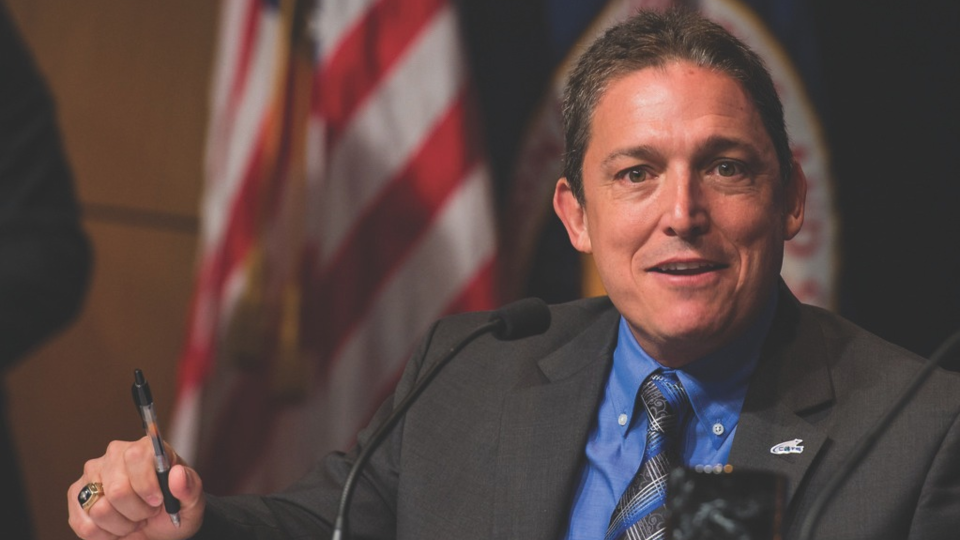
NASA can now buy transportation services from private companies rather than own and operate every rocket and spacecraft carrying crews and cargo into orbit — an approach Embry-Riddle alumnus Alan Lindenmoyer (’83) helped pioneer.
In late 2005, as the space shuttle neared retirement, NASA appointed Lindenmoyer to lead its new Commercial Crew and Cargo Program Office at Johnson Space Center. The challenge was urgent: The International Space Station would still need supplies and crew rotations, but NASA’s planned replacement vehicles would not be ready. The agency faced years of dependence on Russian and other international spacecraft.
Rather than build another government-owned system, NASA offered seed funding and technical support to companies developing their own spacecraft, with the promise of becoming a major customer once the vehicles proved themselves.
The arrangement would change the economics of American spaceflight.
Buying a Ride Instead of a Rocket
Lindenmoyer knew NASA’s traditional system. He joined Goddard Space Flight Center in 1982 as a cooperative education student and became a flight structures engineer after earning his Embry-Riddle bachelor’s degree in Aeronautical Studies with Engineering in 1983. He also left Daytona Beach with commercial and instrument pilot credentials.
In 1987, he moved to NASA Headquarters to work on structural dynamics for Space Station Freedom, which eventually evolved into the International Space Station. By 1990, he was at Johnson Space Center, advancing through senior roles in the station program.
“COTS is a wonderful success story for NASA. The program achieved all its objectives and reenergized the U.S. launch industry to become the largest in the world.”
Alan Lindenmoyer (’83)
His next assignment would challenge much of what he had learned about how NASA got things done.
Commercial Orbital Transportation Services, or COTS, departed from conventional NASA procurement. Instead of dictating designs and paying full development costs, NASA set broad performance goals and released funding as companies met fixed-price milestones. The companies controlled their designs, raised private capital and shared the financial risk.
Among the original partners selected in 2006 was a young venture called Space Exploration Technologies, better known today as SpaceX. When the other original partner, Rocketplane Kistler, failed to meet its milestones, NASA terminated the agreement and subsequently selected Orbital Sciences, now part of Northrop Grumman.
The investment was comparatively modest. For less than $1 billion in NASA funding, COTS helped produce two new launch vehicles and two autonomous cargo spacecraft capable of serving the International Space Station.
“COTS is a wonderful success story for NASA,” Lindenmoyer says. “The program achieved all its objectives and reenergized the U.S. launch industry to become the largest in the world.”
Learning a New Dance
The arrangement demanded a new relationship between NASA and industry. NASA needed oversight to safeguard public money and entrust critical missions to commercial spacecraft without managing companies as traditional contractors. Lindenmoyer worked with SpaceX and Orbital Sciences leaders to establish that balance: NASA defined the capabilities and industry determined how to deliver them.
Former NASA Administrator Charles Bolden recalled building a program without an established model.
“He was pivotal because until he got the job, no one had done it, and we really didn’t know how to do it,” Bolden says.
In 2012, SpaceX’s Dragon became the first commercial spacecraft to deliver cargo to the International Space Station. Orbital Sciences’ Cygnus followed in 2013. Together, they established a continuing commercial resupply capability.
Lindenmoyer also established the first round of Commercial Crew Development agreements, extending the partnership approach to human spaceflight. In May 2020, SpaceX’s Crew Dragon carried NASA astronauts into orbit from American soil aboard a commercially built and operated spacecraft, ending a nearly nine-year gap in U.S.-launched orbital crew missions.
“The key thing is that Alan had the vision and the persistence to push a program through in the face of frequent opposition,” Bolden says. “He was a visionary — a pioneer.”
In 2014, Lindenmoyer received NASA’s Distinguished Service Medal, the agency’s highest honor. The Partnership for Public Service bestowed on him the Samuel J. Heyman Service to America Medal for Management Excellence for his role in developing and executing the commercial partnership model.
The Next Commercial Frontier
What began as an experiment in purchasing access to orbit became a foundation of American spaceflight. Commercial providers now handle much of the routine transportation to low-Earth orbit, allowing NASA to devote more resources to research and exploration beyond it.
Two decades after NASA selected its first COTS partners, the agency is preparing to apply the model to orbital destinations themselves. As the International Space Station approaches retirement, NASA plans to purchase services from commercial facilities rather than own and operate its replacement — becoming one customer among many.
For Lindenmoyer, the story comes full circle.
“I am so thankful to have been a part of this great adventure,” he says, “and look forward to the new partnerships that will forge ahead as NASA reaches deeper in the human exploration of the moon, Mars and beyond.”