
For generations, Eagles have imagined a safer, faster, smarter world and passed that spirit to those who follow. Our faculty innovators are not only expanding the frontiers of flight, space, autonomy and security, but also guiding student researchers who are themselves a legacy in the making.
WEATHER READY SPACECRAFT
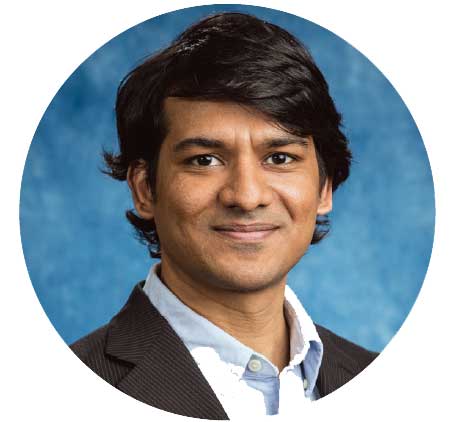
Aroh Barjatya, Ph.D., professor of Engineering Physics and director of the Space and Atmospheric Instrumentation Lab; associate dean of research and graduate studies, College of Arts & Sciences
“Humanity depends on satellites for communication, navigation, atmospheric weather observations and forecasting, and more and the satellite’s survival relies on space weather. Today’s space weather monitoring satellites are sparse, but we are on the edge of a transformation. New instrument technology has produced ultra-small, low-power, low-cost sensors designed for deployment in large constellations. Deployed by the hundreds, they can deliver real-time measurements of key space-weather parameters. Combined with advances in data science, machine learning and AI, these observations promise unprecedented accuracy and speed in predicting near-Earth space weather, ensuring safer satellite operations during intense geomagnetic storms for all modern missions.”
PROTECTED DATA
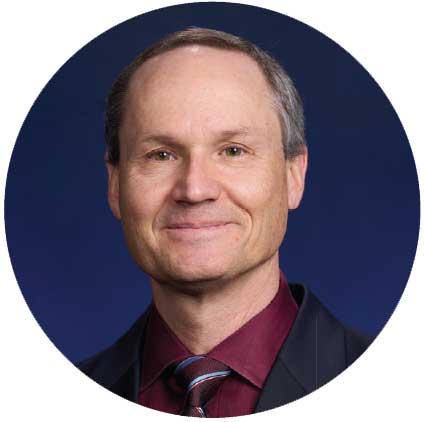
Daniel J. Diessner, executive director of the Center for Aerospace Resilient Systems (CARS) and faculty member in the Department of Electrical Engineering and Computer Science, College of Engineering
“Aviation and aerospace systems advances of the last half century have transformed humanity, driven by rapid advances in computing, communications, cyber, software, sensing and systems modeling and simulation. Future systems will be increasingly connected, software-driven and AI-defined, offering new efficiencies and capabilities, but also introducing risks that require resilient solutions. Intelligent automation and trusted data will enable rapid decisionmaking and safe navigation in flight and space exploration. With progress in explainable AI and system integration, safety-critical domains will anticipate challenges and adapt, reinforcing global security and economic vitality as future generations improve our planet while reaching Mars and beyond.”
FAST-FORWARD FLIGHT
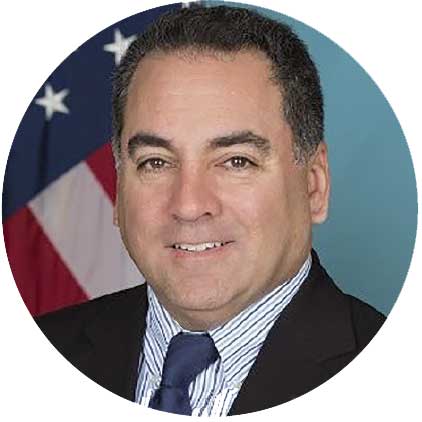
Tony Farina, Ph.D., adjunct assistant professor of Aerospace Engineering, School of Engineering
“Reminiscent of the mid-1940s with supersonic flight, we are at a similar point in the advancement of hypersonic flight technologies. Not just military uses, both offensive and defensive, but also civilian uses are on the horizon. Many large defense contractors have programs geared toward hypersonic flight, as do numerous small and startup companies. Recent and continued innovations in the fields of aerodynamics, propulsion, controls, materials and AI will lead to practical solutions. The payoff is huge — imagine getting a donated organ from New York to Paris in 90 minutes. Hypersonic flight has the potential to revolutionize our lives!”
BUILDING IN SPACE

Yizhou Jiang, Ph.D., assistant professor of Aerospace Engineering, College of Engineering
“In the decades ahead, manufacturing will no longer be confined to Earth. Advances in intelligent, autonomous fabrication will allow us to build and repair spacecraft, habitats and new infrastructure directly in space using local materials. These self-adapting systems guided by AI, robotics and smart materials will transform how we design and sustain everything from satellites to lunar bases. On-demand, low gravity production will cut launch costs, enable new missions and redefine what’s possible in human exploration. The future of manufacturing is not only automated, but also extraterrestrial, resilient and capable of creating the structures that carry humanity farther than ever before.”
AVIATION WORKFORCE IS KEY TO FUTURE INNOVATION

Becky Lutte, Ph.D., associate professor and chair, Department Department of Aeronautics
“The future of aviation will be shaped by how we train and empower those who operate, maintain and manage increasingly complex systems. Workforce advancements will center on innovation in training technology, AI applications and cultural factors such as mental health. Enhanced simulation, virtual reality and the global emphasis on competency-based training will shape the future. AI will boost workforce capabilities by monitoring key parameters, predicting threats and enabling personalized training. To fully benefit, aviation professionals must develop skills to create and apply AI solutions. Technology designed to support, not replace, human judgment will reduce workload, minimize errors and accelerate learning.”
TRUSTED AI
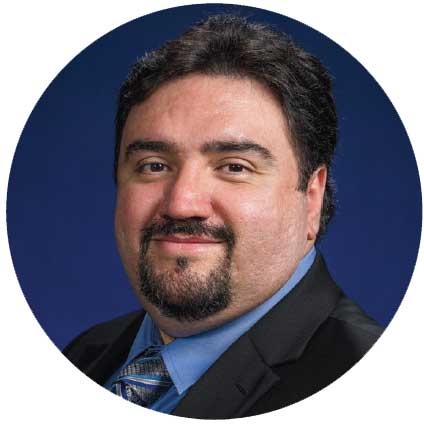
Omar Ochoa, Ph.D., IEEE-CS CSDP, associate professor of Software Engineering and Computer Science, College of Engineering
“Artificial intelligence is transforming how we design and assure complex systems, especially in aviation and other safety-critical domains. The next breakthrough will be AI-augmented engineering workflows that automatically generate, verify and maintain high-assurance software. Advances in explainability, formal verification and trusted data foundations will enable AI tools that can be audited, validated and safely integrated into mission-critical environments. Equally important is preparing the next generation of engineers to use these technologies responsibly by training them to collaborate with AI systems, evaluate their limitations and uphold safety by design to protect the reliability of the systems we depend on daily.”
ENGINEERING HEALTH
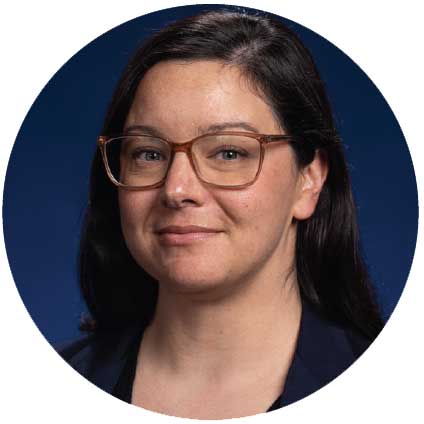
Amber M. Paul, Ph.D., assistant professor of Aerospace Physiology and Immunology, College of Arts & Sciences
“The next breakthrough in aerospace physiology will be predictive, closed-loop health systems that integrate immune monitoring, organoid-based diagnostics and autonomous environmental controls to maintain astronaut health in realtime. These systems will allow spacecraft and habitats to anticipate immune dysfunction and automatically adjust conditions, redefi ning mission duration, crew readiness and deep-space autonomy. Biologically informed design will improve radiation protection, stress mitigation and real-time physiological monitoring for pilots and astronauts alike. Ultimately, this fusion of biology and engineering will shape how we live, work and travel on Earth and beyond. It will also guide training, mission planning, ethics policy and exploration.”
STELLAR DUST ORIGINS

Noel Richardson, Ph.D., associate professor of Physics and Astronomy, College of Arts & Sciences
“In the past five years, the James Webb Space Telescope has revolutionized almost every field of astronomy. My interests in massive stars have led me to work extensively on unusual binary systems that generate dust and may resemble objects formed early in the Universe. The physics governing these binaries is only beginning to be explored in depth. With new telescopes and upcoming satellite missions, we may finally be able to constrain how these systems produce dust, how that dust evolves, and what their broader impact is across cosmic history — from the earliest epochs of star formation to the present day.”
MASTERING SMARTER SYSTEMS FOR A RISKIER WORLD

Tanya B. Corbin, Ph.D., professor and chair, Emergency, Disaster and Global Security Studies, College of Arts & Sciences
“Disaster management technology is advancing and is poised to address unprecedented challenges as disasters are increasing in frequency and severity globally. New AI tools are rapidly emerging that will increase capabilities to help identify disaster vulnerabilities through predictive analytics. This includes applications such as risk modeling, disease outbreak prediction, and flood and wildfire mapping. AI recommendation systems can suggest action plans for resource allocation, shelter options and risk alerts. During emergency response, they will help protect people and property during a disaster event. Generative AI models can process and organize high volumes of unstructured data to guide recovery and future planning.”
SAFER UNCREWED SKIES
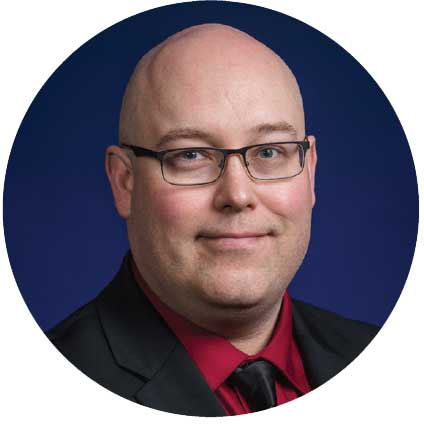
Ryan J. Wallace, Ed.D., professor of Aeronautical Science, College of Aviation
“The rise of uncrewed aircraft systems is revolutionizing the future of flight. Today, uncrewed aircraft outnumber traditional aircraft by a ratio of 13:1. With new technology, however, comes new challenges. Ensuring safe integration of these devices with other aircraft in an increasingly complex and congested National Airspace System requires careful vigilance in developing new procedures, surveillance technology and innovation. Our research team is confronting these difficulties head on, through the novel use of detection technology, geospatial fusion methods and big data analytics. It is exciting to engage students in leveraging these tools to make the skies ever safer for all who fly!”
BUILDING AN ARCHITECTURE OF TRUST IN SPACE
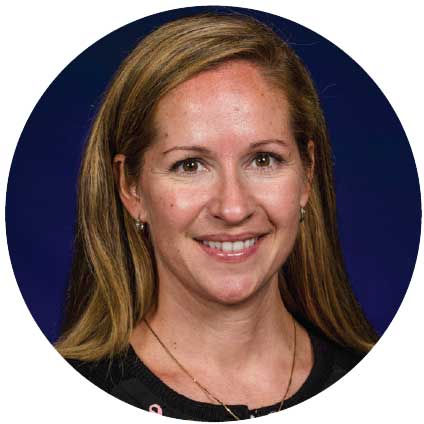
Bettina Mrusek, Ph.D., dean, Worldwide College of Aviation
“Space commercialization is entering its most transformative chapter. Reusable launch systems, in-orbit manufacturing and space-based data services are transforming space from a frontier into critical infrastructure that underpins aviation, communications, navigation and global security. As this ecosystem expands, cybersecurity becomes as essential as propulsion, protecting satellites, autonomous systems and the data streams that guide aircraft and economies. What excites me most is how these challenges accelerate innovation. By designing secure, resilient space systems from the start, we will unlock safer skies, stronger connectivity, and new industries — ensuring the future of aviation is not only more advanced, but trusted and enduring.”
PROTECTED SATELLITES AND SYSTEMS
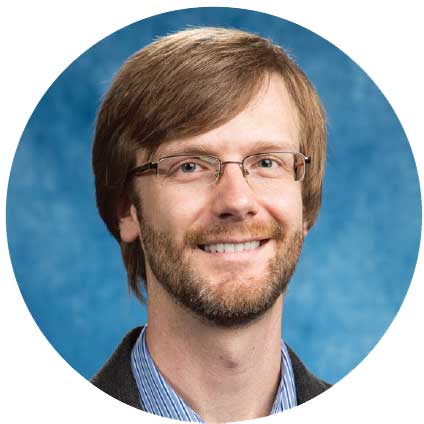
Matthew D. Zettergren, Ph.D., professor of Physical Science and research fellow, College of Arts & Sciences
“Over the past decade, space physics has advanced our understanding of how physical processes influence one another across multiple spatial scales, including auroras shaped by structured electrical current systems. To improve forecasting and operational utility, we must now capture these processes fully in both numerical models and measurements. Instead of continuing to brute-force better approximations, emerging computational capabilities are reaching the point where we can directly simulate at least some multiscale physical processes. This shift promises more accurate predictions and more reliable applications for space operations, strengthening our ability to respond to rapidly evolving space-weather conditions for future mission success.”