
Just like the partnership between T. Higbee Embry and John Paul Riddle 100 years ago, Embry-Riddle Aeronautical University’s philanthropic support grew from one small action — a question asked and an answer given.
Our first recorded philanthropic gift from individuals —made by Walter and Helene Booth in Ormond Beach, Florida — was a check for a few hundred dollars written out to a student experience fund. The couple donated to the university regularly through the 1980s, and their only connection to Embry-Riddle was that they lived near the fledgling Daytona Beach Campus. Embry-Riddle has a history of success because we not only consistently inspire students who have the most ambitious dreams for themselves, we also inspire the people who have ambitious dreams for our students.
Now the university is seeking a new wave of passionate supporters who dream big and expect success. Exactly 50 years since that first recorded gift, Embry-Riddle has set a transformational goal with Imagine What’s Next: The Campaign for Embry-Riddle, seeking $300 million in philanthropic gifts across key growth areas by 2030. When taking the campaign public this spring, the university already made great strides toward the campaign’s success, having raised $175 million.
“This $300 million comprehensive campaign is built around one idea,” says Embry-Riddle Trustee and Campaign Chair Neal Keating. “If we want the future of flight and space to be safer, smarter and more capable, we must invest in the people and innovative spirit that will build that future.”
Thousands of donors since 1966 have been asked if they believe in what Embry-Riddle could become, and they joined together in building that future. With their support, we grew from a school of several hundred students at one campus to an organization with more than 30,000 students who study on three residential campuses and across the globe. Donors have advanced the rapid growth of a research enterprise that attracts the best and brightest innovators. Faculty, staff, alumni and parents of students have banded together to bring to fruition pioneering endeavors such as EagleCam, the first university student-build payload to land on the moon.
“It’s because of scholarships that students like me can continue to pursue our goals. It’s more than financial help — it gives you hope and allows you to focus on what truly matters: your education and your future.”
—Logan Hermes (’24), a quality assurance inspector at Robinson Helicopter Co. and a Marine Corps veteran, received the C. Jeffrey and Katherine Knittel Endowed Scholarship, which enabled him to complete his degree.
“We don’t just imagine what’s next,” says Kelly Dowling, senior vice president for Philanthropy and Alumni Engagement at Embry-Riddle. “We design it, we build it, we test it, we fly it, and we launch it.
“We make what’s next possible through our tradition of innovation and limitless possibility. Every breakthrough this university has achieved over the past 100 years has been powered by partnership. And that same spirit will fuel our future.”
The Future of Embry-Riddle
In 2022, philanthropists Cici and Hyatt Brown made the single largest gift in the university’s history: $25 million to establish the Cici and Hyatt Brown Center for Aerospace Technology. Their gift was matched by the state of Florida.
In just four years, the couple’s investment led to the Center becoming a reality. It opened in 2025 and houses the Boeing Engineering Center, which supports the engineering design, research, development and prototyping for Boeing Defense, Space & Security Air Dominance programs, as well as advanced technology efforts.
“Look what’s happened already. In 10 years I can’t begin to imagine what it’s going to be like. The potential is just off the charts.”
—Cici Brown and her husband, Hyatt, made the single largest gift in the university’s history. Their $25 million gift led to the creation of the Cici and Hyatt Brown Center for Aerospace Technology at Embry-Riddle’s Research Park. As residents of Volusia County, Florida, they have witnessed the university’s rise and its role in driving innovation and economic growth.
The Browns ensured that their commitment would transform students’ experience by supporting scholarships and stipends for undergraduate and graduate students who intern at the Embry-Riddle Research Park, where the Brown Center is located.
This agile, innovative leap forward was made possible by imagining what Embry-Riddle could achieve and acting on that conviction.
Trustee Keating says that the launch of a campaign requires leadership and commitment. “It requires the promise and courage of people who understand and honor the century that brought us here and have the vision to infl uence and create the century yet to come,” he says.
“I am asking you to unite with Embry-Riddle as we begin to Imagine What’s Next.”
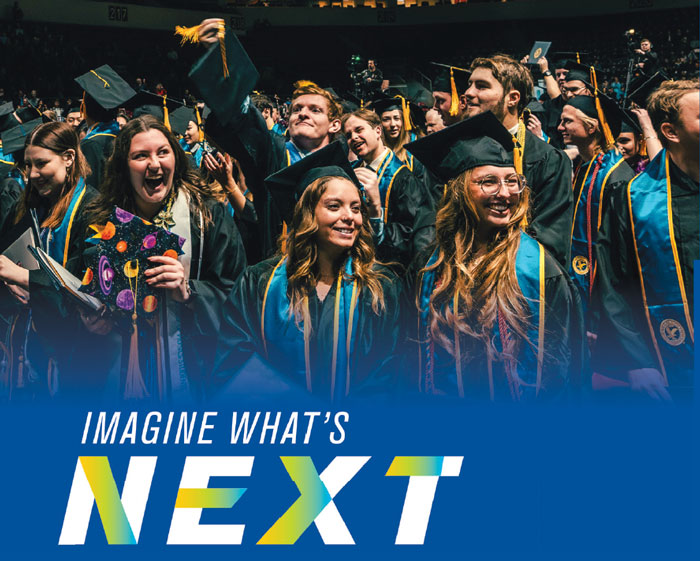
Campaign at a Glance
Imagine What’s Next: The Campaign for Embry-Riddle is an invitation to invest in four priorities that will define Embry-Riddle’s next century:
 SCHOLARSHIPS AND STUDENT SUCCESS. By supporting scholarships, we remove barriers so that every high-potential Eagle can earn the education they deserve and transform their dreams into reality.
EXPERIENTIAL LEARNING. By investing in learning through doing, we expand the tools, experiences and projects available to our Eagles so that when they take flight, they’re ready to lead from day one.
FACULTY EXCELLENCE. By creating endowed chairs, professorships and center directors, we attract, hire and develop faculty members who set the highest standard in teaching and scholarship, and help our students reach their greatest potential.
CENTERS OF EXCELLENCE. By building Centers of Excellence, we solve the toughest industry challenges — bringing the right people to work together with the best tools, the best data and the urgency to deliver results.
Imagine What’s Next — and Make It Real
Join us. Be part of shaping the next century of innovation and discovery. Visit next.erau.edu.